 Sunglasstest
Sporty Luxury Sunglasses: High-End Performance Picks
The notion that performance eyewear must sacrifice aesthetics for function is a relic of the past. For the seasoned collector, the truly discerning athlete, or the professional who demands optical excellence in every environment,…

The notion that performance eyewear must sacrifice aesthetics for function is a relic of the past. For the seasoned collector, the truly discerning athlete, or the professional who demands optical excellence in every environment, the merger of luxury craftsmanship with elite sports technology has created a distinct and highly rewarding category: Sporty Luxury Sunglasses. These are not simply casual frames with a slight curve; they are precision instruments, honed for specific activities yet built with the superior materials and visual refinement of high-fashion eyewear.
My personal journey through decades of testing has taught me that the difference between an ordinary pair of sports sunglasses and a luxury performance pair is akin to the difference between a mass-produced digital watch and a Swiss-made chronograph: it is a matter of heritage, material science, and an unwavering commitment to distortion-free visual clarity. The investment is justified not by the logo, but by the tangible improvement in comfort, durability, and, most critically, visual performance.
The Core Value Proposition: Beyond UV Protection
In the high-end sporty segment, the foundation is, of course, impeccable protection. Every reputable manufacturer in this class offers a non-negotiable 100% block against UVA, UVB, and UVC radiation up to $400 \text{ nm}$. This is the baseline. What elevates the luxury contenders is the lens technology and the frame’s kinetic architecture.
Where an average lens uses a simple tinted dye, premium manufacturers—such as those behind the specialized optics of Maui Jim, the contrast-enhancement of Oakley’s Prizm, or the photochromic brilliance of Serengeti’s drivers’ lenses—employ complex, multi-layered filtration systems. These systems are tuned to manipulate the light spectrum itself, not just darken the view.
For instance, when testing a pair of performance sunglasses on a bright, high-glare road for a cycling review, the difference is startling. Lesser lenses merely dim the world; superior lenses actively enhance contrast and depth perception by selectively filtering out ‘visual noise’—the specific wavelengths that cause your brain to work harder, leading to eye fatigue. The result is a richer, sharper, and less strenuous visual experience over hours of wear.
“As I always tell people when they invest in their first pair of premium sunglasses, you are not buying a fashion accessory; you are investing in a superior visual interface with the world. The goal is to see better, not just look good.”
Materials Science: The Art of Lightweight Durability
The frame construction of sporty luxury eyewear is a masterclass in material engineering. These frames must be featherlight to prevent pressure points, yet durable enough to withstand high-velocity impact, significant torsional flex, and corrosive elements like sweat and saltwater.
The most common and effective materials in this space are high-grade Nylons and proprietary thermoplastics, such as Grilamid TR90. This polymer is renowned for its extreme flexibility and memory retention; you can twist the temples nearly flat, and the frame will spring back into its original geometry. This is crucial, as any warping, even minor, can introduce optical distortion and ruin the secure, anti-slip fit.
For a select few ultra-high-end models, we see the integration of aerospace-grade metals like Beta-Titanium or Carbon Fiber. While substantially increasing the price, these materials offer an unparalleled strength-to-weight ratio. I once tested a titanium-framed model during a high-altitude hike—the kind of environment where every ounce counts and metal frames can often become cold and brittle. The frame remained comfortably warm against the skin and felt practically weightless, a stark contrast to heavier acetate that can cause nose bridge discomfort on a multi-hour trek.
Experiential Fit and Ergonomics
The ‘fit’ on performance eyewear is not a single dimension; it’s a system of three-point contact: the nose bridge and the two temple tips. Luxury brands excel here through sophisticated ergonomic design and proprietary grip compounds.
- Secure Grip: Look for hydrophilic (water-loving) elastomers or rubberized temple tips and nose pads. These materials actually increase their tackiness when exposed to moisture—be it rain or heavy sweat. When I took a shield-style pair on a sweltering 10-mile run, the frame, which felt perfectly snug but not tight at the start, actually felt more locked in place as the run progressed and my skin became slicker. There was zero bounce or slip, which is the hallmark of true performance design.
- Optimal Ventilation: Another key element is ventilation. Wraparound and shield-style frames provide excellent coverage but can trap heat and fog up, especially when you stop moving. The best designs incorporate discreet brow-bar vents or lens cut-outs to manage airflow. This simple, subtle engineering detail—often visible only upon close inspection—is the difference between crystal-clear vision at the apex of a climb and a maddening, temporary white-out.
Lens Mastery: The Visual Edge
Beyond 100% UV filtration and basic polarization, the lens is where the luxury quotient truly manifests.
Specialized Tints and Contrast Enhancement
The pinnacle of performance optics involves tints engineered for specific environments.
- On Water (Marine): Lenses often feature a heavy base tint with a strong polarization filter to obliterate horizontal glare off the water’s surface, allowing an angler to see below the surface. A blue or grey mirror coating often reflects harsh surface light.
- On Road/Trail (Cycling/Running): A rose, bronze, or amber base tint is often preferred. These colors heighten contrast by boosting the orange, red, and yellow spectrums, making subtle changes in road texture, trail debris, and shadows ‘pop’ against the green and blue background. This improved definition gives the user an invaluable fraction of a second more reaction time.
- All-Conditions (Golf/Varying Light): Photochromic (or adaptive) lenses are the ultimate luxury. Using special molecules embedded in the lens, they transition their tint level based on the intensity of UV light. I have tested these during long transitional days—starting a golf round in morning mist and finishing in blazing afternoon sun—and the lens perfectly and seamlessly adjusted, eliminating the need to carry two separate pairs. This is a level of subtle performance that is priceless for consistency.
The Superiority of Glass and High-Index Composites
While most sports frames utilize impact-resistant Polycarbonate or Trivex lenses for safety, the absolute peak of optical clarity is still often achieved with proprietary glass or advanced composite materials.
- Mineral Glass: Brands like Vuarnet and Serengeti are famed for their mineral glass lenses. Glass is inherently distortion-free and offers unmatched scratch resistance. One seasoned collector once told me, “If you want to experience color fidelity as if the world has been digitally remastered, you have to look through glass.” While heavier, their absolute clarity remains the gold standard for activities where weight is less critical than flawless vision, like driving or competitive sailing.
- Advanced Composites (SR-91, MauiBrilliant): These materials seek to bridge the gap, offering the clarity approaching glass with the low weight and impact resistance of polycarbonate. They are the ideal compromise for the athlete who refuses to accept any degradation in their field of view.
Longevity, Care, and Realistic Expectations
A pair of sporty luxury sunglasses is a long-term piece of equipment. With superior anti-scratch, hydrophobic (water-repelling), and oleophobic (oil/smudge-repelling) coatings, they will maintain their optical integrity far longer than budget alternatives.
Durability and Care
The frames are built to be flexible, but they are not indestructible. The performance advantage lies in their ability to endure repeated, non-catastrophic stresses—bending, high heat exposure, and constant sweat.
- Cleaning Guidance: Always rinse them under lukewarm water before wiping. Even microscopic dust particles become abrasive sandpaper when you wipe a dry lens. Use the high-quality microfiber cloth provided, and periodically clean the hydrophilic nose and temple pads with a mild soap and water solution to restore their critical grip properties.
- Longevity: Expect the hinges to remain tight and the fit to maintain its tension for years. Unlike cheaper nylon that can become brittle over time, the proprietary high-performance polymers are engineered for decades of service.
The final verdict on sporty luxury sunglasses is this: The investment provides a clear, competitive, and experiential edge. The superior optics reduce strain, the engineered fit eliminates distraction, and the high-grade materials guarantee consistency and durability. For the enthusiast or professional athlete, they are not a costly accessory, but an essential piece of technical equipment that seamlessly enhances your performance and your perception of the world.
Continue reading
More from Buying Guides

Photochromic Lenses: Do Transition Sunglasses Actually Work?
Photochromic lenses darken in UV light and clear indoors - but they barely work behind a windshield. How transition lenses work, where they fail, and when they are worth buying.
How to Choose Sunglasses: The Order That Actually Works
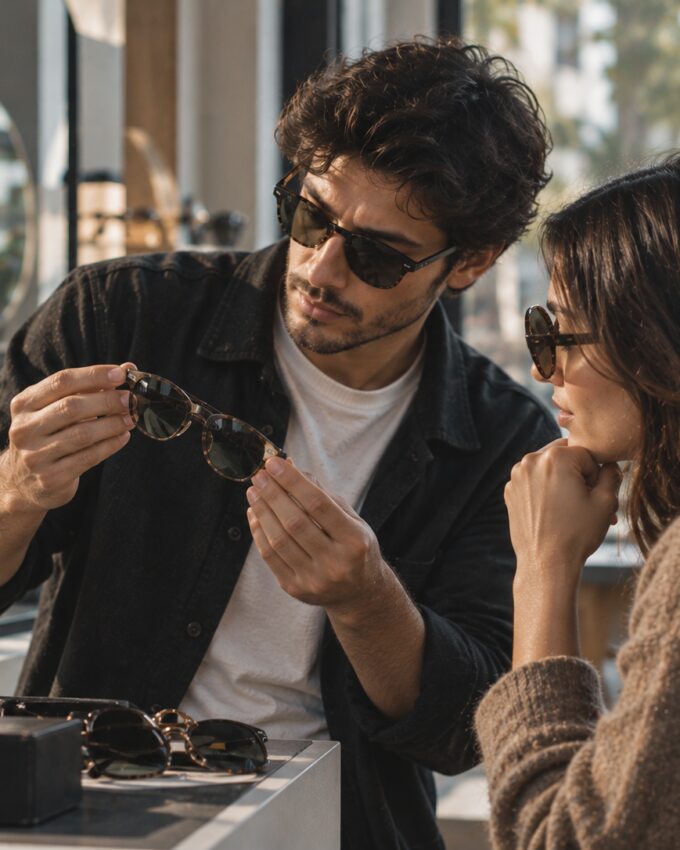
Most people buy sunglasses backwards, starting with looks. Purpose, UV rating, size, shape, construction, then a ten-minute wear test - the sequence that narrows the wall fast.
